
Richmond City Directory Holdings
The verified Richmond city directory shelf has one fully inspected digital volume and two leads that require confirmation. Southern Bell's March 14, 1966 telephone directory is public through Lexington Public Library ContentDM. An EKU heritage reference points to an 1895 Richmond Telephone Company directory, but its scan was not independently inspected. A Kentucky Historical Society catalog page mentions “Richmond City Directories” with 1981 shelf data, yet the city and state are ambiguous. Neither lead should be cited as a confirmed Richmond, Kentucky volume until staff verify it.
| Collection | Years | Where Held | Access |
|---|---|---|---|
| Southern Bell telephone directory | March 14, 1966 | Lexington Public Library ContentDM | Free 70-page viewer |
| Richmond Telephone Co. lead | 1895 | EKU heritage reference | Item scan not confirmed |
| “Richmond City Directories” lead | 1981 | Kentucky Historical Society catalog | City, state, and publisher need confirmation |
| Directories in Ancestry Library Edition | Collection dependent | Madison County Public Library | In-library database access |
No official source supplied a complete publisher list or uninterrupted run. Ask Madison County Public Library, Madison County Historical Society, EKU's Dorris Museum, and Kentucky Historical Society for holdings by title and year. Do not fill a gap with an unsourced index.
Ask staff to distinguish telephone books from commercial city directories, reverse books, classified sections, and government staff lists. A reverse directory, when one exists, is arranged from address to subscriber. Richmond's exact criss-cross years were not established. Save the title page and publication statement before extracting entries, since a loose page can conceal the city, publisher, and date.
The 1966 Richmond Directory Book
The confirmed volume is titled 1966 Telephone Directory for Richmond, Ford, Kirksville, Waco. Southern Bell published it on March 14, 1966. Its 70 pages also contain Berea and Paint Lick material, plus residents, businesses, and advertisements. Treat each result as a subscriber or business listing within that publication, not as an official census.
Open the Lexington Public Library directory item before consulting the captured view.
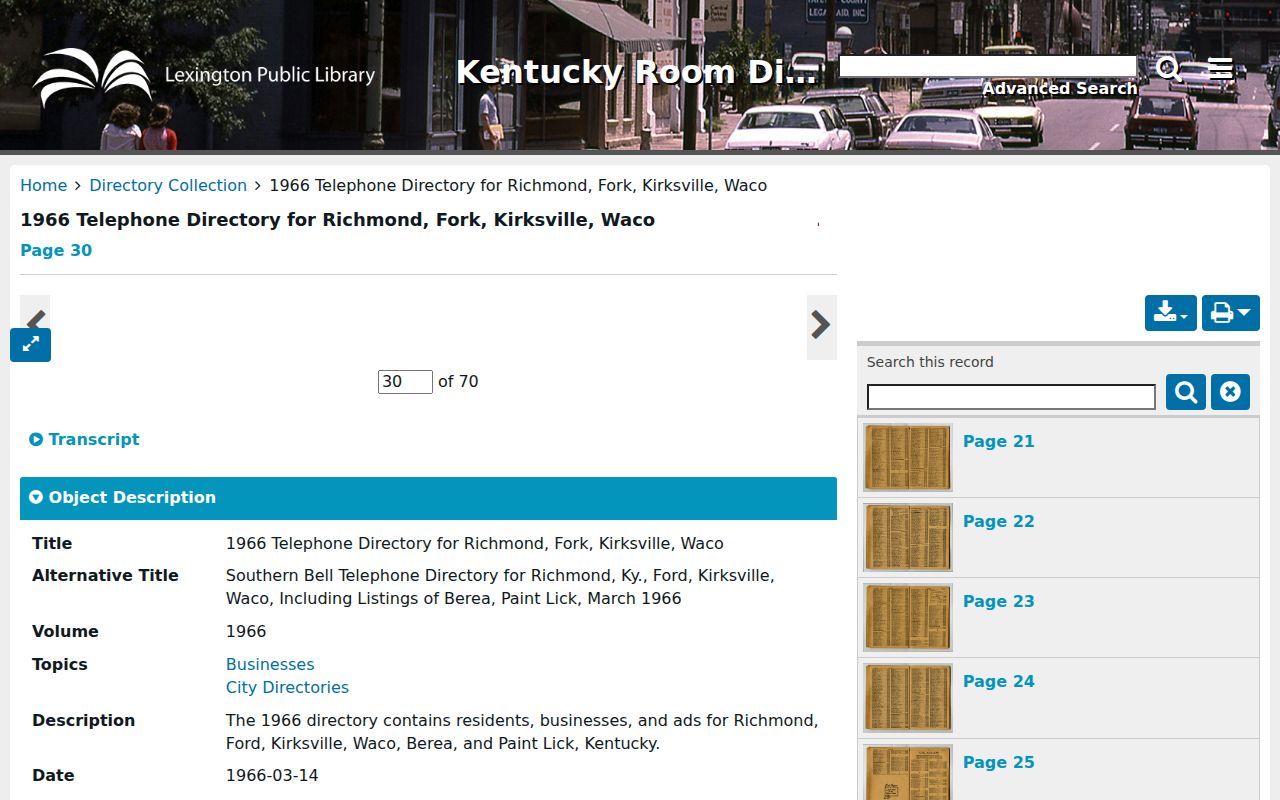
The digital record supplies title, date, publisher context, page count, and a page viewer. Save those details with a name or address transcription.
Search each community label separately. A person associated with Richmond in one record might appear under Ford, Kirksville, Waco, Berea, or Paint Lick in this book. Preserve initials, punctuation, and street spelling on the first pass. Then test a normalized form. Business advertisements can also connect an owner, trade name, phone, and location, but an advertisement may have been prepared before publication. Label it as advertising evidence and confirm its date through newspapers, deeds, or business records.
The 1966 book should not be stretched into an uninterrupted household history. Compare its subscriber and address with the 1950 census, then look for a dated newspaper notice between those points. A current PVA parcel can help locate the place, while County Clerk deeds can test ownership. These sources speak to different facts. The telephone book documents a published listing, the census records a household at its enumeration date, PVA describes an assessment parcel, and a deed records a land interest. When two names differ, retain both with their dates. The difference may reflect a move, an unlisted family member, a renter, a business line, a transfer, or a same-name person.
Richmond Directory Help at the Library
Madison County Public Library's Richmond branch is at 507 W Main Street and can be reached at 859-623-6704. Its genealogy research page describes in-library Ancestry Library Edition access for directories, census, vital, immigration, military, court, photographs, and maps. HeritageHub offers obituaries, death notices, and news. NewsBank and separate newspaper links broaden the search.
Local historian Todd Moberly is named on the library's one-on-one assistance page. The listed appointment blocks were first Mondays from 9:00 a.m. to 1:00 p.m. and third Mondays from 1:00 to 5:00 p.m. Confirm the current date and branch before visiting. Bring a person, address, likely year, and source already checked.
Review the library's current genealogy routes alongside the screenshot below.
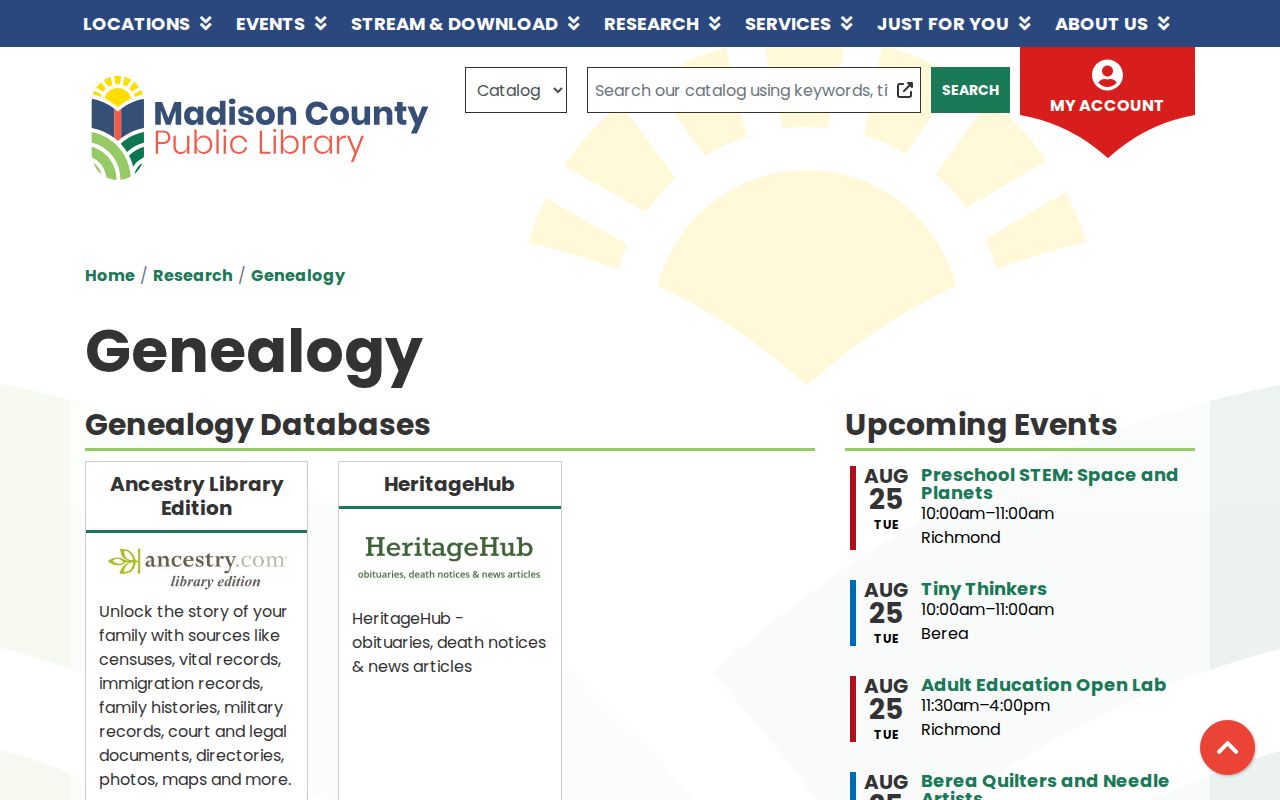
The page confirms that library help extends beyond one directory volume to databases and local indexes needed to test a listing. Local links include a Madison County marriage index for 1786 through 1956, burial inventories, and municipal minutes.
HeritageHub is described by the library as spanning 1704 to today, with original newspaper images where available and remote access through the library. Vendor coverage can change, so enter through the library's current research page rather than saving a deep database link. For every obituary or notice, record the newspaper, issue date, page, database name, and whether the image was available. Family-supplied notices can contain errors, so compare relationships and dates with clerk, cemetery, or certified vital records.
Read a Richmond City Directory Entry
Start with fields actually visible in the 1966 item: publication title, publisher, date, page number, alphabetical or business section, listed name, telephone when relevant, address, community, category, and advertisement context. Do not assume that generic directory marks appear in this local volume. The research did not confirm spouse, owner, renter, widow, or occupation notation in a fully transcribed Richmond entry.
| Publication | Title, publisher, and full date |
|---|---|
| Page context | Page number and alphabetical, business, or advertisement section |
| Listed party | Name exactly printed, with initials preserved |
| Contact line | Telephone and address only when shown |
| Place label | Richmond or the named nearby community |
- Criss-cross directory
- A volume or section arranged by street and address, useful when the surname is unknown.
- Householder index
- An index organized around named household leads, whose fields vary by publisher.
- Abbreviation key
- The publisher's legend for shortened terms. Save it before interpreting any mark.
A city directory entry is a dated lead. It can direct a search to census, newspaper, cemetery, parcel, or deed evidence, but cannot prove ownership or continuous residence.
Richmond Directory Evidence by Era
Richmond history is spread across records made for different purposes. A timeline prevents a later source from being read backward into an earlier period.
| Year | Richmond evidence |
|---|---|
| 1786 | County deeds, marriages, wills, and court orders begin |
| 1800 | Madison County plats begin |
| 1879 | Richmond telephone system begins |
| 1886 | Three-sheet Richmond Sanborn map |
| 1904-1935 | Historical voter registers include Madison County |
| 1950 | Latest released federal population census |
| 1966 | Verified Southern Bell telephone directory |
The gaps matter. An 1895 directory remains a lead, and the complete run has not been established. A “Richmond” result may also sit in a county precinct, postal area, or nearby community rather than present city limits. Retain the original district and community wording.
Richmond Directory and Census Images
The National Archives provides the 1950 census, the latest released federal population schedule. Under the 72-year rule, the 1960 schedule is due in 2032. A directory name near 1966 can be tested in 1950, but moves, deaths, and boundary changes may intervene. Search Madison County, Richmond precinct, and enumeration district, then inspect the page because OCR can misread names and street labels.
Use the National Archives 1950 census route before reviewing the assigned capture.
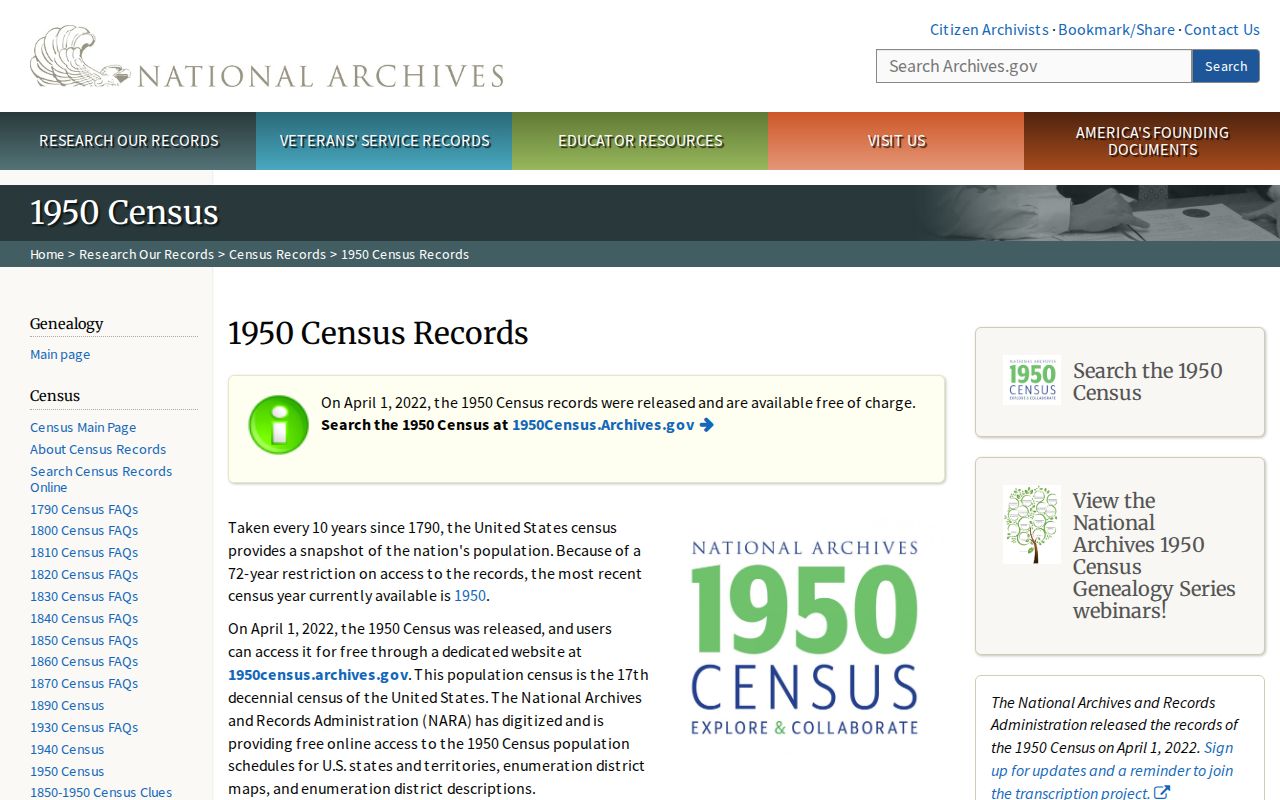
The archive page is the official path to schedules and research aids. Its image evidence can add household relationships that a telephone listing does not show.
Richmond Newspapers Fill Directory Gaps
Madison Library routes researchers to HeritageHub, NewsBank, the Richmond Register, and Berea Citizen. Library of Congress records identify The Climax in Richmond from 1887 through 1897 with 356 issues, and The Climax-Madisonian from 1914 through 1917 with 68 issues. Title variants may overlap.
Search a full name, initials, relative, Richmond, Madison County, church, cemetery, and known street. Record the publication, date range, and whether the database used full text or OCR, which is machine-read text that can misread old print. A missed OCR search does not show that no notice exists. Confirm family dates through clerk, cemetery, or vital sources.
Richmond Local Collection Contacts
The Madison County Historical Society at 121 Aspen Avenue supports genealogical research, preservation, publications, and county-history programs. Its detailed manuscript catalog and fee schedule were not found. Send a focused query with a name, street, organization, and date range.
EKU Digital Collections holds 784 scanned Madison County Commissioners Deeds dated 1791 through 1979, though the series is incomplete. These are not city directories, but a deed can verify a party or property clue. Kentucky Historical Society can inspect the ambiguous 1981 entry. Such fallbacks matter because no complete online Richmond directory run was located.
Madison County Historical Society also preserves the local context needed to interpret terse entries. Its town and village history notes that Richmond's telephone system began in 1879 and was Kentucky's first outside Louisville. That fact explains why an 1895 telephone-directory lead is plausible, but it does not verify the uninspected item. Ask the Society or EKU for the publication title, publisher statement, page count, physical location, and a scan of the title page. A catalog confirmation should come before any person-level transcription. This careful sequence keeps a promising local lead distinct from the verified Southern Bell volume.
Trace Family Through Richmond Directories
Use each Richmond city directory hit as a dated point, then test it against a second record from the same era. Census images can reveal household relationships, while newspapers and cemetery indexes may explain why a name appears or disappears.
- Save title, date, page, spelling, address, community, and listing type.
- Search adjacent years or ask the library which physical volumes bridge the gap.
- Compare the closest released census image and enumeration district.
- Test the address in newspapers, maps, parcels, and deeds without assuming the subscriber owned it.
- Use an obituary, marriage index, probate holding, or cemetery record to explain a disappearance.
A missing listing can mean a move, death, changed spelling, unlisted service, publisher omission, or changed community label. It does not prove absence. For present-day address records, use the Richmond street directory.